Blog
The Hidden Cost of AI: Understanding Tokens and "Token Burn"
If you’ve been following the AI space this week, you’ve likely heard the chatter about Anthropic’s re-release of Claude Fable 5. While the tech world is marveling at its capabilities, a new phrase is dominating the conversation: "token burn." Business owners are logging into their accounts to find their daily usage limits vaporized in minutes or their API bills skyrocketing. The AI is doing incredible work, but it is chewing through computing power to get it done.
Whether you run a local bakery, a plumbing service, or a boutique marketing firm, understanding how AI consumes resources is becoming essential to using these tools effectively without disrupting your workflow.
What Are Tokens?
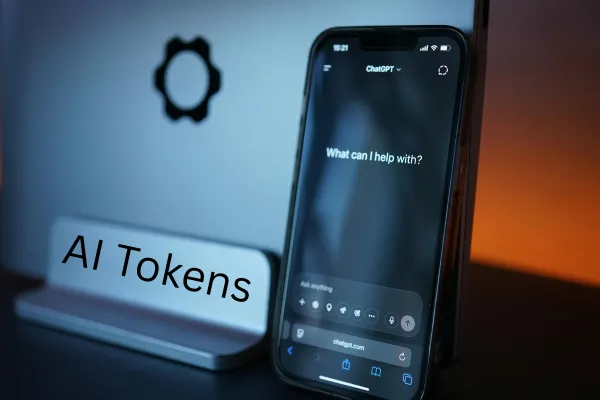
In the world of Large Language Models (LLMs), a token is the fundamental unit of data the AI reads and generates.
You can think of a token as a chunk of a word. A helpful rule of thumb is that 1 token is roughly equal to 4 characters of text, or about 3/4 of a standard English word.
A short word like "cat" is one token.
A longer word like "unbelievable" might be broken into two or three tokens.
Punctuation marks and spaces also count as tokens.
When you send a prompt to an AI, the system breaks your text down into these tokens. When the AI replies, it generates its response one token at a time.
The $20/Month Question: Why Does This Matter to You?
If you are a business paying a flat $20 a month for a subscription like ChatGPT Plus or Claude Pro, you might be thinking: "I pay a flat rate. Why should I care about tokens or API costs?"
Because flat-rate subscriptions are not unlimited. Your $20 subscription comes with an invisible "usage quota" based on how much computing power you use. Historically, you could chat with an AI all day without hitting this limit. But new, powerful models like Fable 5 do a massive amount of invisible "thinking" behind the scenes before they type a single word.
If you ask a heavy-duty model to do a simple task, it will burn through your account's token quota exponentially faster. Instead of getting 100 messages a day, you might hit your limit in just 5 or 6 prompts. You will find yourself locked out of your AI assistant by 10:00 AM on a Tuesday, right when you urgently need it to draft a proposal for a major client. Understanding token burn is about protecting your access and your productivity.
The Landscape of LLMs and Token Costs
For businesses that integrate AI into their software or automate tasks via APIs (where you pay precisely for what you use), token costs vary wildly depending on the "brainpower" of the model.
Here is a breakdown of current popular models, their providers, and their estimated costs per 1 million tokens (about 750,000 words):
Note: Output tokens (the text the AI writes and the "thinking" it does) are always significantly more expensive than Input tokens (the text you provide).
Real-World Examples: The Cost of Everyday Routines
To understand how token burn impacts businesses, let's look at how choosing the wrong model can drain your limits or your wallet
.
1. The Landscaping Dispatcher (Automated API Routing)
A local landscaping company uses an AI integration to scan incoming customer emails, categorize them (e.g., "Quote Request" vs. "Complaint"), and draft a quick reply.
Using a standard model (e.g., Claude 3.5 Sonnet): The AI reads the email and categorizes it in one step. Cost per email: ~$0.001.
Using a heavy model (e.g., Claude Fable 5): The model reads the email, "thinks" internally about the schedule, critiques its own response, checks its work, and finally replies. Cost per email: ~$0.05.
The Impact: If they get 100 emails a day, the standard model costs them about $3 a month. The Fable 5 model costs them $150 a month for doing the exact same simple job.
2. The Local Bakery (Manual Subscription Use)
A neighborhood bakery uses their $20/month AI subscription to write weekly social media posts and brainstorm seasonal flavors.
The Routine: They ask the AI to generate 5 Instagram captions for their new summer pastries.
The Problem: They select Fable 5 from the drop-down menu because it is the "newest and best." Fable 5 treats this simple request like a complex marketing thesis. It burns 10,000 tokens generating invisible internal reasoning on target demographics before spitting out the captions.
The Impact: After asking for a few tweaks to the captions, the bakery receives an error message: "You have reached your usage limit for this model. Please try again in 4 hours." They are now locked out of their tool for half the workday just because they used a sledgehammer to crack a nut.
Make AI Work for Your Bottom Line
The newest AI models can do the work of a junior engineer or analyst, but you have to manage them like one. Keep an eye on the meter, be mindful of your daily limits, and ensure you are using the right model for the right job. You don't need a Formula 1 race car to drive to the grocery store, and you don't need a premium reasoning model to write a polite email.
Navigating the world of AI does not have to be overwhelming. By understanding how tokens work and choosing the right tool for the job, you can keep your costs low and your productivity high. AI should empower your business, not drain your resources.
Ready to integrate AI into your local business without the headache of unpredictable costs? We help businesses like yours build smart, cost-effective tech strategies. Contact us today for a free consultation.